
WP Inventory

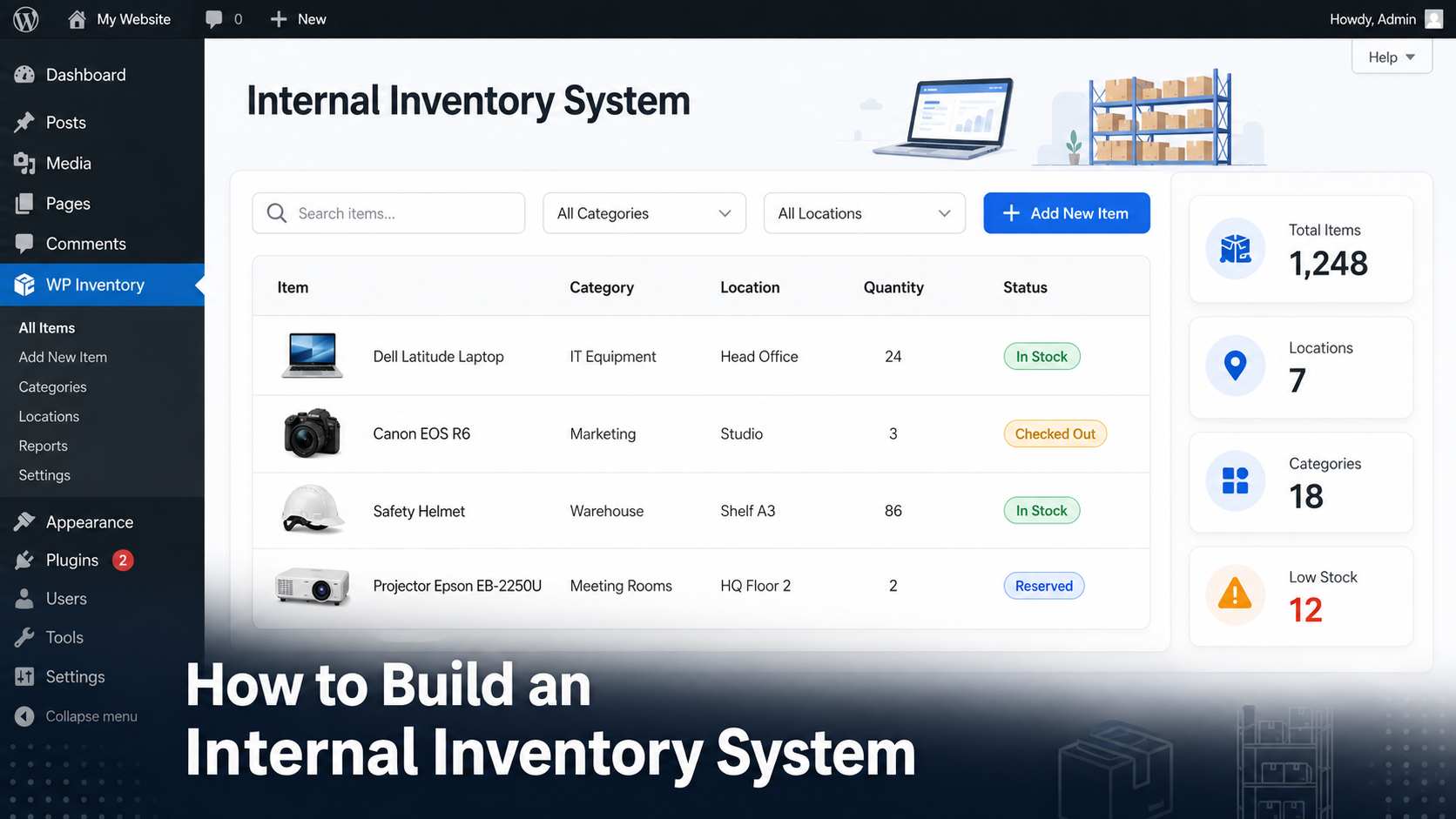
How to Build an Internal Inventory System in WordPress

Most businesses don’t lose inventory because people steal it, they lose track of it. Equipment gets moved between offices, tools never make it back to storage, and spreadsheets quickly become outdated. An internal inventory system solves this by giving your entire team one central place to manage inventory, assets and equipment.

Whether you manage office equipment, warehouse supplies, rental gear or company assets, this guide explains what an internal inventory system is, why spreadsheets eventually become a liability, and how you can build one in WordPress without investing in expensive enterprise software.

What is an internal inventory system?

An internal inventory system is software that helps an organization track the items it owns and uses internally. Unlike ecommerce inventory software, its purpose isn’t to sell products online. Instead, it keeps accurate records of equipment, supplies, tools and assets used by employees or departments.

Examples include:

Industry Items commonly tracked
Corporate offices Laptops, monitors, phones, desks and office furniture
Manufacturing Tools, spare parts, safety equipment and consumables
Schools Chromebooks, tablets, projectors, science equipment
Churches & nonprofits Audio equipment, chairs, event supplies and storage inventory
Rental businesses Camera gear, AV equipment, sports equipment and event rentals

The goal is simple: know what you own, where it is, how many you have, and who is responsible for it.

Why spreadsheets stop working

Almost every business starts with Excel or Google Sheets. They’re free, familiar and easy to share.

Unfortunately, they were never designed to become inventory systems.

Example: Your IT department buys twenty laptops. HR keeps one spreadsheet, Finance keeps another, and IT updates a third. Three months later nobody agrees how many laptops remain in storage.

As your inventory grows, spreadsheets create problems that become increasingly expensive to fix.

Spreadsheet Internal inventory system
Multiple copies exist One centralized database
Manual searching Instant search and filtering
Easy to overwrite data Controlled updates and permissions
No audit trail Complete inventory history
Hard to share publicly Searchable inventory on your website
No automation Imports, reservations, reports and add-ons

One of the biggest issues is synchronization. Once inventory exists in multiple spreadsheets, or in both WordPress and Excel, the numbers eventually diverge.

We explain why this happens and how to prevent it in our guide to fixing out-of-sync inventory in WordPress.

Signs you’ve outgrown Excel

You don’t necessarily need enterprise inventory software. But if any of the following sound familiar, it’s probably time to move beyond spreadsheets.

  • Multiple employees edit the same inventory.
  • You frequently ask “Who changed this quantity?”
  • You can’t quickly find a specific item.
  • Different departments maintain separate inventory files.
  • Your inventory includes photos or documentation.
  • You manage inventory across multiple locations.
  • You regularly import or export inventory.
  • Your website and inventory database are separate systems.

If you’re currently maintaining inventory in Excel, migrating doesn’t have to mean starting from scratch. WP Inventory Manager includes import tools, and our guide on importing inventory from a spreadsheet walks through the migration process step by step.

What features should an internal inventory system include?

Not every inventory application offers the same capabilities. Before choosing one, make sure it can grow with your business.

A searchable inventory database

The heart of any internal inventory system is a centralized database. Every asset, piece of equipment or inventory item should exist only once, giving everyone in your organization a single source of truth.

Instead of scrolling through hundreds of spreadsheet rows, employees should be able to search by:

  • Item name
  • SKU
  • Serial number
  • Category
  • Location
  • Custom fields

As your inventory grows into the hundreds or thousands of items, powerful search quickly becomes one of the most valuable productivity features. The Advanced Search add-on extends WP Inventory Manager with additional filtering capabilities for larger inventories.

Categories and organization

Not every organization structures inventory the same way. A construction company might organize equipment by project, while a school organizes it by classroom and a nonprofit by ministry or event.

A good inventory system should let you organize items into meaningful categories without forcing a rigid structure.

Example: A marketing agency may create categories such as Cameras, Lighting, Audio Equipment, Laptops and Trade Show Material. Employees can immediately narrow the inventory to the equipment they need instead of browsing one long list.

Custom fields for your business

Every organization tracks different information.

Some businesses only need quantities, while others need purchase dates, warranty expiration, assigned employee, manufacturer, condition or maintenance records.

That’s why custom fields are essential. Rather than adapting your workflow to the software, the software should adapt to your inventory.

Industry Useful custom fields
IT Department Asset tag, assigned employee, operating system
Construction Project, maintenance date, inspection status
Schools Room number, teacher, academic department
Rental companies Replacement value, rental rate, condition

Location tracking

One of the biggest causes of “missing” inventory is that nothing is actually lost, it has simply been moved.

Whether you operate from multiple warehouses, offices or storage rooms, recording each item’s location dramatically reduces the time employees spend searching for equipment.

For organizations managing larger stockrooms, our guide to warehouse inventory management in WordPress explores additional organization strategies.

Inventory history

Knowing today’s quantity is useful.

Knowing why that quantity changed is even more valuable.

An inventory history lets you answer questions like:

  • Who updated this item?
  • When was stock adjusted?
  • Why was inventory removed?
  • Was this item reserved or sold?
  • How often does this equipment move?

If detailed transaction history is important to your organization, our guide explaining what an inventory ledger is explains how every inventory movement can be automatically recorded.

Who needs an internal inventory system?

Although inventory software is often associated with warehouses and retailers, many organizations benefit from tracking internal assets instead.

Corporate IT departments

IT teams manage laptops, monitors, networking equipment, peripherals and mobile devices. Knowing which employee has each asset significantly reduces replacement costs and simplifies hardware audits.

Churches and nonprofits

Churches often own hundreds of items that move between services and events, from microphones and speakers to folding chairs, projectors and children’s ministry supplies.

Our dedicated guide to church inventory management covers this use case in more detail.

Gyms and fitness centers

Fitness businesses need to track equipment purchases, maintenance schedules and replacement planning.

See our guide to gym equipment inventory tracking for a practical example.

Rental businesses

Rental companies need more than quantities, they need to know what is currently available, what has been reserved and what is due back.

WP Inventory Manager can be extended with Reserve Cart, allowing customers to reserve inventory directly from your website while maintaining accurate stock availability.


How to build an internal inventory system in WordPress

You don’t need expensive enterprise software to manage internal inventory effectively. If your organization already uses WordPress, you can build a centralized inventory database without adding another platform for your team to learn.

WP Inventory Manager was designed specifically for organizations that need to track inventory, equipment and assets without the complexity of an ecommerce solution.

Step 1: Create your inventory database

Start by defining the information you want to track for every item.

Typical fields include:

  • Item name
  • SKU or Asset ID
  • Category
  • Current quantity
  • Storage location
  • Serial number
  • Purchase date
  • Condition
  • Assigned employee or department

Because every organization is different, WP Inventory Manager lets you extend items with custom fields instead of forcing you into a predefined structure.

Step 2: Import your existing inventory

If you’ve already built an inventory spreadsheet, don’t recreate everything manually.

Most businesses already have years of inventory data stored in Excel or Google Sheets. Importing that information dramatically reduces migration time while preserving your existing records.

Our guide to importing inventory from a spreadsheet explains how to prepare your data before importing it into WP Inventory Manager.

Tip: Before importing, spend a little time cleaning duplicate records and standardizing category names. A clean import saves many hours of maintenance later.

Step 3: Organize your inventory

As your inventory grows, organization becomes more important than data entry.

Use categories, locations and custom fields consistently so employees can quickly find what they’re looking for.

Instead of searching through hundreds of items, someone should be able to filter the inventory down to exactly what they need within seconds.

Step 4: Track inventory history

Inventory quantities change every day. Recording those changes gives valuable context when something doesn’t look right.

For example, if an item’s quantity unexpectedly drops, a history log can immediately show whether it was adjusted manually, reserved for a customer or removed from stock.

If you need complete transaction history including costs, reservation status and invoices, our Inventory Ledger guide explains how to automatically record every inventory movement.

Step 5: Extend your inventory system as you grow

One advantage of using WordPress is that your inventory system can evolve with your business.

As requirements become more sophisticated, WP Inventory Manager can be extended with add-ons including:

Common mistakes to avoid

Even with dedicated inventory software, a few simple mistakes can reduce the accuracy of your inventory.

Mistake Better approach
Keeping multiple spreadsheets Maintain one centralized inventory database.
Using inconsistent categories Define categories before importing data.
Ignoring inventory history Track every significant inventory movement.
Choosing ecommerce software for internal inventory Use software designed specifically for internal inventory management.

Frequently Asked Questions

What is the difference between inventory management and asset management?Inventory is generally consumed, sold or replenished. Assets are long-term items such as laptops, tools or equipment that remain owned by the organization. Many businesses track both within the same internal inventory system.

Can I build an internal inventory system without WooCommerce?Yes. WP Inventory Manager was built specifically for businesses that need inventory tracking without running an online store.

Can multiple employees manage inventory?Yes. WordPress user roles make it possible to control who can add, edit or manage inventory records.

Can I publish my inventory online?Yes. Many organizations use WP Inventory Manager to create searchable public equipment catalogs while keeping administrative controls inside WordPress.

Build an inventory system your whole team can trust

Replacing spreadsheets doesn’t just improve organization, it gives your team confidence that everyone is working from the same information.

With WP Inventory Manager, you can build a centralized inventory database, organize equipment, track inventory history and extend your system as your organization grows, all without leaving WordPress.

Ready to move beyond spreadsheets?

Discover how WP Inventory Manager helps businesses, schools, nonprofits and rental companies manage equipment, assets and internal inventory from one centralized WordPress application.

Explore WP Inventory Manager →

5 Best WordPress Inventory Management Plugins in 2026 (Compared)

Search “best WordPress inventory plugin” and you’ll find the same list repeated everywhere: ATUM, Smart Manager, WooCommerce Stock Manager. All solid tools. All built for online stores.

Quick answer:

  • Best without WooCommerce: WP Inventory Manager. Free, unlimited items, searchable front-end catalog
  • Best for WooCommerce stock control: ATUM. Purchase orders and suppliers in the free tier
  • Best for bulk editing a large WooCommerce catalog: Smart Manager
  • Best for a visual catalog with light inventory needs: Ultimate Product Catalog
  • Good enough for small stores: WooCommerce’s built-in stock management

If you run a WooCommerce store, skip to ATUM and Smart Manager below. They are the right tools for you and we say so. But if you are tracking equipment, managing a parts catalog, running an asset register, or building a browsable inventory without a shopping cart, those tools solve a different problem than the one you have.

This comparison breaks that down honestly.

There are two completely different jobs here

Before comparing plugins, it helps to name the two distinct things people mean when they say “WordPress inventory management.” They are not the same job, and the plugins built for each are not interchangeable.

Job A: Store Stock Control Job B: Catalog / Asset Inventory
Who Runs a WooCommerce shop Tracks items, may not sell online at all
Need Sync stock to orders, purchase orders, suppliers Display a searchable catalog, track quantity and status
Examples Retailer with 2,000 SKUs, dropshipper, marketplace seller Equipment rental, museum, parts catalog, asset register
Best fit ATUM, Smart Manager WP Inventory Manager

WooCommerce-based tools cannot do Job B without adding a full store engine you don’t need. WP Inventory Manager doesn’t do Job A: there’s no checkout, no order sync, no supplier purchase orders. That’s not a weakness. It’s the design.

Plugin by plugin

WP Inventory Manager: Best inventory management without WooCommerce

Model: Fully standalone. No WooCommerce dependency. Uses its own database tables and displays via the [wpinventory] shortcode on any page.

Free tier: Genuinely unlimited items, custom fields, categories, front-end search and sort, and full admin management. Most small businesses never outgrow the free tier.

Paid add-ons: Pro ($79.99/yr) unlocks support and access to add-ons such as low-stock email alerts, quantity history and min/max quantity fields. Add-ons include Advanced Search ($39.99/yr), Locations Manager ($39.99/yr), Reserve Cart ($29.99/yr), and Import/Export ($59.99/yr) among others. The All Access bundle at $199/yr includes all add-ons, unlimited sites and support.

Best for: Equipment rental, art and museum collections, parts catalogs, internal asset tracking, nonprofits, schools, gyms. Anyone who needs a searchable front-end catalog without an online store.

Honest weaknesses: No payment processing or checkout. Reserve Cart captures reservation requests, not sales. No WooCommerce stock sync. No native supplier or purchase order workflow.

Real-World Fit

A brewery tracks kegs, equipment, and ingredients across two locations. Staff update stock from the WordPress admin. Distributors browse available items on the front end. No store, no cart, no checkout. Just a clean catalog that actually works.

ATUM: Best for advanced WooCommerce inventory management

Model: WooCommerce add-on, requires WooCommerce to function. 10,000+ active installs.

Free tier: Unusually powerful. Stock Central dashboard, purchase orders, suppliers, inventory logs, and statistics are all free. Most stores never need the paid version.

Best for: WooCommerce stores that want serious inventory control without leaving WordPress. If you’re already on Woo and need supplier management or purchase orders, ATUM is the answer.

Honest weaknesses: Completely useless without WooCommerce. Installing Woo just to use ATUM adds significant weight to your site and forces a store architecture you may not need.

Smart Manager (StoreApps): Best for bulk editing large WooCommerce catalogs

Model: WooCommerce add-on. Spreadsheet-style bulk editor for products, orders, and stock. Free lite version; Pro from $149/yr (single site).

Free tier: Smart Manager Lite covers basic bulk editing of products and stock. Advanced columns, order editing and bulk update rules are in the paid version.

Best for: Stores editing hundreds or thousands of SKUs at once. Price updates, stock adjustments, attribute changes in bulk. Solves a specific operational bottleneck, not a catalog display problem.

Honest weaknesses: It is an editing tool, not an inventory system. No front-end display, no locations, no purchase orders, and nothing to offer if your items are not WooCommerce products.

Native WooCommerce Stock Management: Best free WooCommerce stock dashboard

Model: Built into WooCommerce, free. Handles per-product stock, low-stock emails and backorders.

Best for: Stores under roughly 500 SKUs that need stock counts and nothing more.

Honest weaknesses: No suppliers, no purchase orders, no multi-location stock, no bulk editing. Beyond a few hundred products most teams add ATUM or Smart Manager on top.

Ultimate Product Catalog: Best for a visual catalog with light inventory needs

Model: Standalone catalog plugin, no WooCommerce needed. Free version with a paid Premium tier.

Best for: Showcasing items with images and filters where quantity tracking is secondary. Showrooms, restaurants, brochure-style catalogs.

Honest weaknesses: Display first, inventory second. No quantity workflow, no reservations, no locations, no ledger. If you need to know how many you have and where they are, it is the wrong tool.

What about building your own with ACF? Advanced Custom Fields gives you total flexibility, but no inventory logic out of the box, and you need a developer. WP Inventory Manager sits between the two: purpose-built for tracking quantity and status, with a front-end display and no development work.

Side-by-side comparison

Feature WP Inventory Manager ATUM Smart Manager Native Woo
Requires WooCommerce No Yes Yes Yes
Front-end catalog display Yes (shortcode) No No No
Unlimited items (free) Yes Yes Lite limits Yes
Custom fields Yes Product meta only Product meta only Product meta only
Multi-location stock Add-on ($39.99/yr) Add-on (paid) No No
Purchase orders / suppliers No Yes (free) No No
Reservation / request flow Add-on ($29.99/yr) No No No
Free to start Yes Yes Lite only Yes

Is WP Inventory Manager right for you?

Choose WP Inventory Manager if you… Choose ATUM / Smart Manager / Woo if you…
Don’t run (or want) a WooCommerce store Already sell through WooCommerce
Need a browsable, searchable front-end catalog Need stock to decrement automatically on each order
Track equipment, art, vehicles, parts, or assets Manage supplier relationships and purchase orders
Want unlimited items free with custom fields Need multi-warehouse e-commerce stock control
Need reservation requests rather than online sales Take payment and check out on-site
Have stock across multiple physical locations Need to bulk-edit thousands of product SKUs at once

If you’re building an inventory without a shopping cart, ATUM and Smart Manager are the wrong category of tool entirely. You’d be installing a store engine to solve a catalog problem. On the other hand, WP Inventory Manager was built specifically for the catalog and asset tracking use case, and the free tier covers more ground than most businesses need.

Need inventory management without WooCommerce?

Track equipment, assets, collections, parts and other inventory directly inside WordPress.

Explore WP Inventory Manager

Which WordPress inventory plugin is best for your use case?

The easiest way to choose an inventory plugin is to start with what you are actually trying to track.

Use Case Recommended Solution Why
Internal asset tracking WP Inventory Manager Track equipment, ownership, location, status, serial numbers and custom fields without ecommerce.
Equipment rental WP Inventory Manager Create searchable equipment inventories and handle reservation requests without building a full online store.
Museum or art collection WP Inventory Manager Manage collection metadata and display a searchable public or private catalog without checkout.
Parts or spare-parts catalog WP Inventory Manager Organize parts by category, SKU, compatibility, location, quantity, and custom attributes.
School or nonprofit inventory WP Inventory Manager Maintain an asset register without configuring or maintaining an ecommerce platform.
WooCommerce store with advanced stock control ATUM Add suppliers, purchase orders, inventory logs, and more advanced WooCommerce stock workflows.
Large WooCommerce catalog needing frequent edits Smart Manager Bulk-edit products, prices, and inventory through a spreadsheet-style interface.
Simple WooCommerce stock management Native WooCommerce Built-in stock quantities, backorders, and low-stock alerts may already cover straightforward ecommerce needs.

Use case: Internal asset tracking

A company may need to track laptops, monitors, tools, furniture, or other equipment assigned to employees. These items are not products for sale, so creating WooCommerce products for every asset adds unnecessary ecommerce functionality.

WP Inventory Manager can store information such as serial number, location, assigned employee, condition, purchase date, and asset status using custom fields.

See our internal asset tracking example for a more detailed workflow.

Use case: Equipment rental

A rental business might maintain hundreds of cameras, power tools, event supplies, or pieces of industrial equipment. Customers need to browse what is available while staff need to manage quantities and item information internally.

In this case, the requirement is closer to an inventory catalog than a traditional ecommerce store.

Our guide to equipment rental inventory in WordPress explains how this type of system can be structured.

Use case: Art gallery or museum collection

Galleries and museums often need to catalog artworks or objects with fields such as artist, medium, dimensions, acquisition date, location, status, and collection.

They may also want visitors or staff to search the collection without showing prices or offering checkout.

See how to create a searchable online art catalog in WordPress.

Use case: Parts catalog

A manufacturer, repair company, or distributor may need a searchable catalog containing thousands of replacement parts. Customers or staff might search by SKU, category, model, manufacturer, or compatibility rather than purchasing immediately.

A standalone inventory plugin can provide that catalog without forcing every item into an ecommerce workflow.

Display your parts inventory on your website with searchable listings, custom fields, images and inquiry options.

Ready to build your inventory in WordPress?

Start with WP Inventory Manager and add advanced features as your inventory needs grow.

View Plans & Pricing

Frequently Asked Questions

Can WP Inventory Manager replace WooCommerce for inventory?

Only if you don’t need WooCommerce’s core function: processing online sales. WPIM is purpose-built for catalog and asset inventory without a store. If you need customers to check out and pay, you need WooCommerce alongside or instead of WPIM.

Is ATUM really free? What’s the catch?

ATUM’s free tier is genuinely strong – purchase orders, supplier management, stock dashboards, and inventory logs are all included at no cost. However, the catch is that it requires WooCommerce, which means you’re carrying the full weight of an e-commerce platform even if you don’t need it.

What’s the best free WordPress inventory plugin?

For WooCommerce stores: ATUM’s free tier is hard to beat. For non-WooCommerce catalog and asset tracking: WP Inventory Manager gives you unlimited items, categories, custom fields, and front-end display at no cost. Unlimited item, no trial period.

Can I show my inventory on the front end without a store?

Yes – this is exactly what WP Inventory Manager does with its shortcode display. Visitors can browse and search your catalog. You control which fields show, and no one can check out or purchase directly. On top of this, the Reserve Cart add-on handles reservation requests if you need them.

Do I need technical skills to set up WP Inventory Manager?

No. Installation is standard WordPress plugin setup: upload, activate, done. Adding items and categories works through the admin dashboard. The shortcode drops your inventory onto any page. No coding required for core setup or the majority of add-ons.

30-day money-back guarantee

Reviews on WordPress.org

Trusted by 134,000+ businesses since 2013

★★★★★

"Created an online museum for my club. Really impressive plugin. Support was responsive and helpful."

@hackrepair

★★★★★

"Excellent, clean, simple inventory management. Well structured code — use it right away or customize it to your liking."

@techlocally

★★★★★

"We purchased the entire suite. Installation was easy, small issues were fixed immediately, and the guidance during setup was invaluable."

@design4dotcom

★★★★★

"Plugin support was helpful and rapid. Highest mark."

@drgar

★★★★★

"Great support. Very thorough when looking for a solution, and upfront with exactly how to fix it or institute a workaround."

@shoidahl

★★★★★

"I used this plugin and eventually hired the developers for all my WordPress work. Responsive, competent, and clean code. Would recommend to anyone."

@justenhong